The following content is excerpted from the prospectus of Neo Performance Materials Inc. dated October 17, 2017 filed on SEDAR.
Rare Earth Elements
 Permanent Rare Earth Magnet Industry >>
Rare Earth Separation and Processing Industry >>
Permanent Rare Earth Magnet Industry >>
Rare Earth Separation and Processing Industry >>
Catalyst Industry
Products engineered from REOs are used in the production of fluid catalytic cracking ("FCC") catalysts for crude oil refining and in auto
catalysts. According to Roskill, estimated demand of REOs used in catalyst applications in 2016 was 29,000 tonnes
with approximately 65 to 70% used for FCC catalysts and approximately 20 to 25% for auto catalysts. FCCs are a
comparatively commoditized product, while auto catalysts are a comparatively higher value, specialized product
REOs are ideal inputs for engineered auto catalyst solutions as the thermal stability provided by
REEs enhances the performance and extends the durability of the catalyst, allowing it to operate more efficiently at
high temperatures. These functional materials are highly specialized and vary from customer to customer, uniquely
engineered depending on their requirements. Developing auto catalyst applications requires close collaboration with
customers and long lead times, providing existing producers with a competitive advantage. In some cases, these lead
times can be over three years due to the testing and qualification processes required by customers.
Complex auto catalysts use a combination of rare earth-based functional materials and PGMs to minimize and
control exhaust emissions. Rare earth-based functional materials provide thermal stability that augments the catalytic
activity of PGMs. Umicore, Johnson Matthey, BASF and Cataler Corporation are the leading global
manufacturers of these complex auto catalysts.
Tightening air emission standards are a significant driver of growth in the industry. For example, both China and
India are adopting E.U. emission standards V and VI. These E.U. standards define the acceptable limits for exhaust
emissions of new vehicles sold in the E.U. and EEA member states. The emission standards are defined in a series of
E.U. directives staging the progressive introduction of increasingly stringent standards.
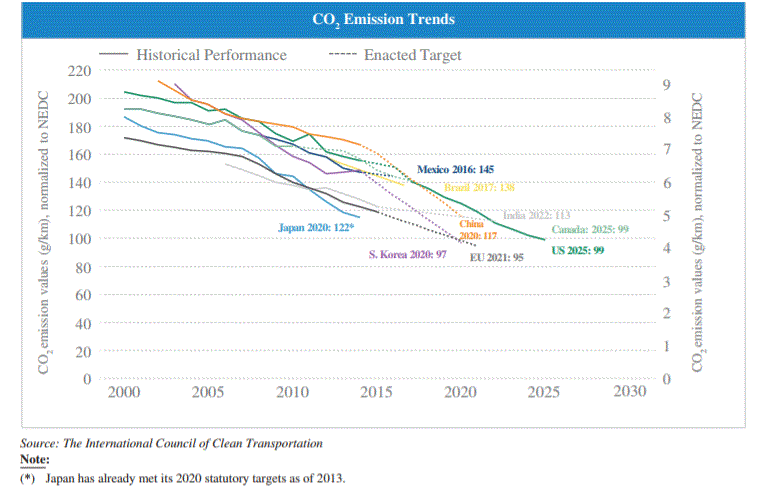
The chart below provides an overview of anticipated government regulation of air emissions, based on data
compiled by the International Council of Clean Transportation, an independent non-profit organization that provides
technical and scientific analysis to environmental regulators. The new European driving cycle ("NEDC") is a driving
cycle designed to assess the emission levels of car engines and fuel economy in passenger cars (which excludes light
trucks and commercial vehicles). The increasingly complex catalyst innovations will be required
for auto catalyst manufacturers to comply with stricter emission standards. This in turn requires companies to
innovate new technologies and develop new functional materials in collaboration with auto catalyst manufacturers to
meet expected demand.
Source: Neo Performance Materials Inc. Prospectus filed on SEDAR dated October 17, 2017
Continued Reliance on Combustion Engines in Hybrid Electric Vehicles
Stricter emission regulations, lower battery costs, widely available charging stations and increasing consumer
acceptance are expected to drive strong momentum for the increased penetration of electrified vehicles (hybrid,
plug-in, battery electric and fuel cell). However, it is important to note that a large portion of electric vehicles include
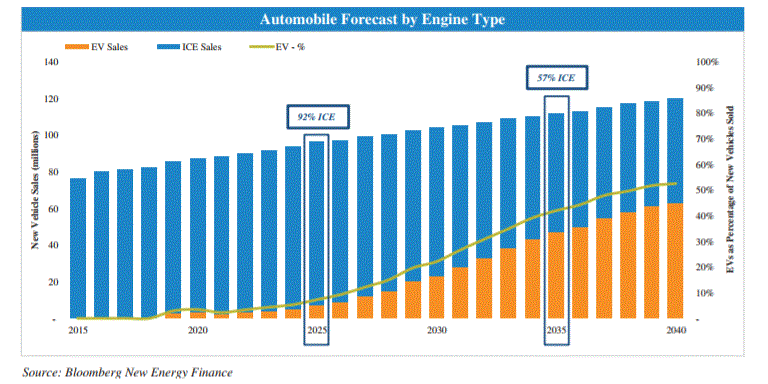
hybrid electric vehicles, which utilize a combination of ICEs and batteries. According to Bloomberg, 92% of new
vehicle sales will include ICEs (including HEVs) in 2025 and 57% of new vehicle sales will include ICEs (including
HEVs) in 2035. This means that in 2035, approximately 65 million new vehicle sales will still include ICEs. As a
result, it is expected that demand for auto catalysts will remain strong for the foreseeable future.
Source: Neo Performance Materials Inc. Prospectus filed on SEDAR dated October 17, 2017
Complex Auto Catalyst Growth
Umicore highlights stricter government regulations as the key driver of global emission-control catalysts, leading
to market growth for complex auto catalysts of a 7.8% CAGR from 2015 to 2020. The highest growth regions are
expected to be emerging markets such as China (24.6% CAGR) and India (28.9% CAGR). According to
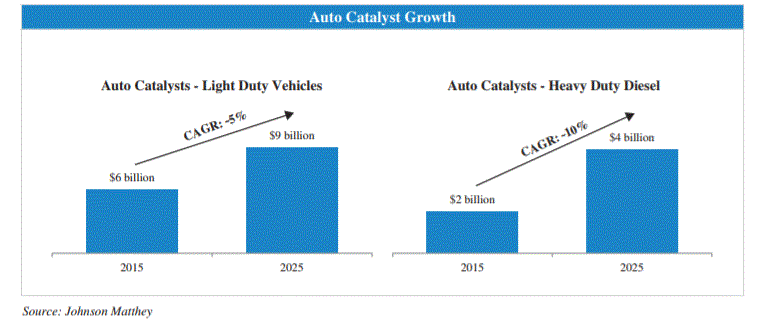
Johnson Matthey, growing demand for complex auto catalysts will be driven by increasing numbers of vehicles
(including HEVs), and stricter regulations. Johnson Matthey, anticipates market growth of approximately 5% per year
from 2015 to 2025 for light duty vehicles and approximately 10% per year for heavy duty diesel over the same period.
Source: Neo Performance Materials Inc. Prospectus filed on SEDAR dated October 17, 2017

